I studied physics at the Technische Universität Berlin and, on
exchange, at the University of Nairobi, Kenya. In 2013 I completed my
PhD (Dr. rer. nat.) with a dissertation on collective and critical
effects in bosonic transport — quantum effects in heat transport at
atomic scales — followed by a postdoctoral fellowship at the Max
Planck Institute for the Physics of Complex Systems in Dresden.
From 2015 I worked as a freelance programmer, developing a prototype
tangible musical interface based on RFID technology. In 2016 I
joined the Max Planck Institute for the History of Science in Berlin
as a postdoctoral researcher and research software engineer, working
with the Cluster of Excellence Topoi at Humboldt-Universität zu
Berlin on research data infrastructure. I subsequently moved into
the research program History of the Max Planck Society, working on
large-scale analysis of archival data, before becoming postdoc and
then principal investigator of the BMBF-funded ModelSEN project on
socio-epistemic networks. From 2023 I was a senior research fellow at
the Max Planck Institute of Geoanthropology, working on modeling the
evolution of knowledge in the Anthropocene; I remain affiliated there
as a guest researcher. That work also has a public-facing side:
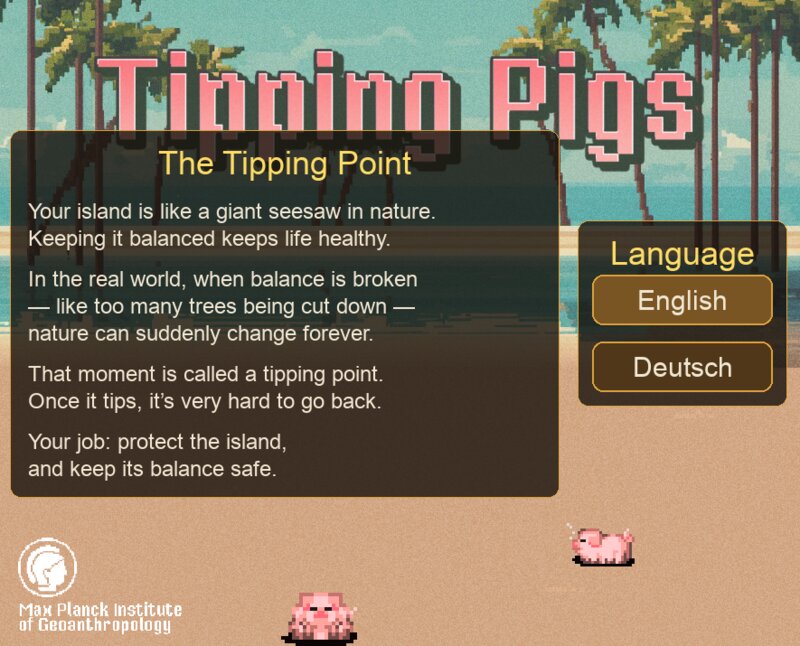
Tipping Pigs is a serious
game I built about ecological tipping points, communicating the same
kind of cascading, hard-to-reverse dynamics through play. Since
September 2026 I work as a software
architect and developer at the
Berlin-Brandenburg Academy of Sciences and Humanities
(BBAW) in Berlin in the TELOTA project.
ModelSEN developed the socio-epistemic
networks (SEN) framework: a way of formally describing historical
knowledge systems along three interconnected layers — social,
semiotic (material), and semantic — so that network studies from
different historical case studies become comparable. Methodologically,
it combines social network analysis, diffusion theory, and graph
theory with ontology-based semantic modeling, grounded in case
studies from the history of science. Software built along the way
includes CitationNet, an
interactive 3D visualization of citation networks,
semanticlayertools,
a Python toolkit for building the framework’s network layers from
any structured text corpus, and
RDMHelper, a set of
tools for research data management.
I am a member of DHTech, the German
Digital Humanities association
DHd, and the Deutsche Physikalische
Gesellschaft. Within DHTech I take part in the
community code review process,
both submitting my own code for review and reviewing others'.
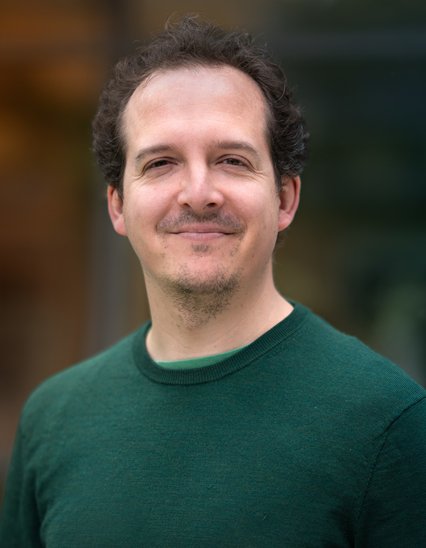
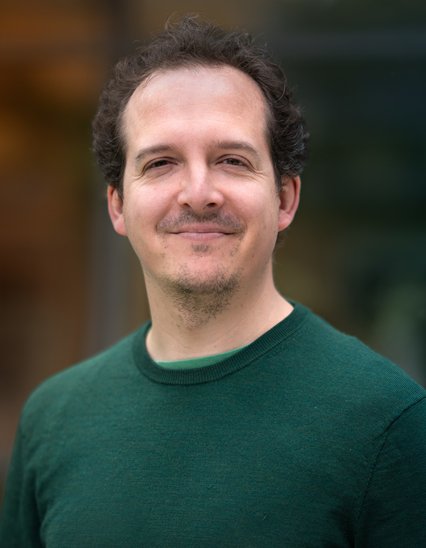
Portrait: © Hans Sell, Max Planck Institute of Geoanthropology.
Methods and tools I work with:
- Python
- Network analysis
- Agent-based modeling
- Natural language processing / LLMs
- Historical data analysis
- Research software engineering