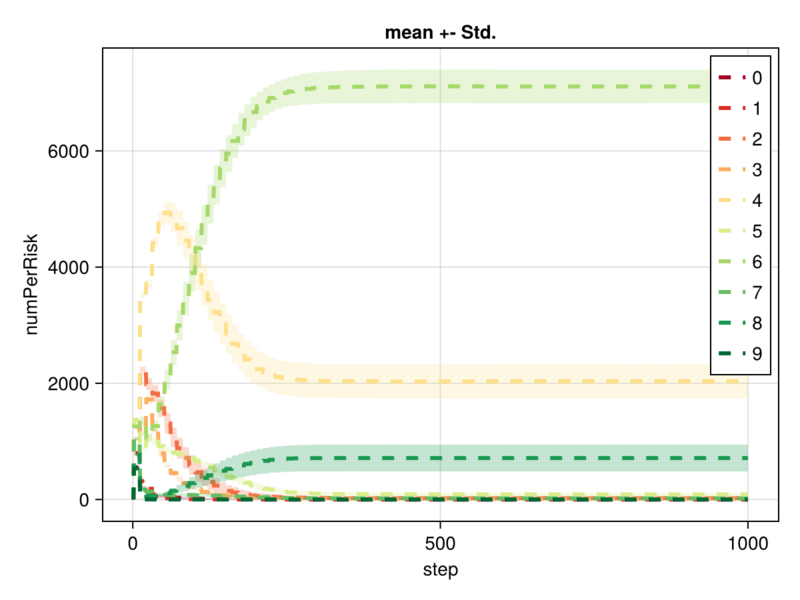
HawkDove.jl simulates a spatial Hawk-Dove game in which players differ in their attitude toward risk. Agents play against their neighbours, updating their strategy each round and, periodically, adapting their risk attitude toward that of more successful neighbours. A small-world rewiring parameter lets the observation network diverge from the spatial grid, which turns out to matter: for some parameter ranges the population converges to being predominantly risk-averse, but that convergence is sensitive to how much rewiring is introduced. The model is a Julia rewrite, built on the Vahana.jl framework, of a Python/Mesa model from Princeton’s SimulatingRisk.
This is unpublished, ongoing work with no accompanying paper — documented here anyway, on the principle that research software is worth a public record even before (or absent) a formal publication.
Explore the code
- Author: Malte Vogl, with contributions from Gesine Steudle
- Status: unpublished, work in progress
- Repository: gitlab.gwdg.de/mpigea/dt/hawkdove.jl