Posts
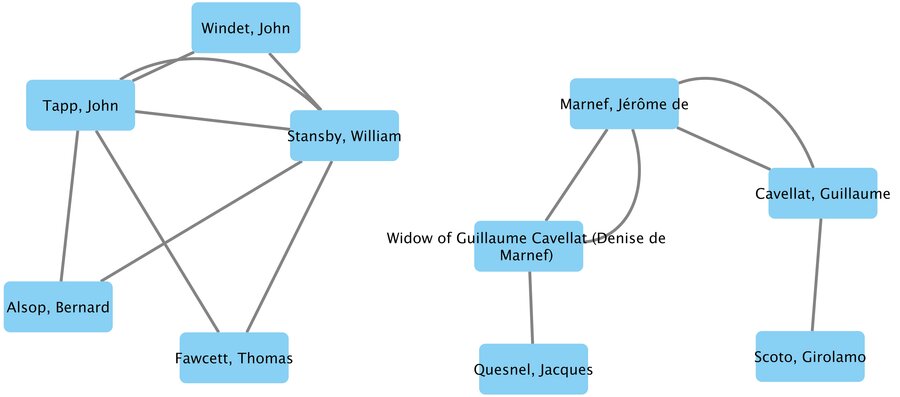
New paper: The Network of …
Printers and publishers were among the most decisive — and understudied — agents in how scientific knowledge changed in the early modern period. This paper describes a computational method for reconstructing clusters of social relationships among them, using standard bibliographic data and …
New white paper: ModelSEN …
Written up by fourteen participants of the April 2022 ModelSEN workshop, this white paper brings together perspectives on modeling historical knowledge processes — spanning network analysis, agent-based modeling, and the socio-epistemic networks framework — as a shared reference point for the …
New talk: Using …
Bibliometric resources like Dimensions are usually built for evaluating current researchers and institutions — using them for historical research raises a different set of questions. How complete is the dataset going back in time? Do modern research-area classifications even apply to older periods? …
New video: Die Expedition …
To mark 100 years of the Deutsche Forschungsgemeinschaft (DFG), a “Centre of Curiosity” combining questions, performance, and science was staged in Berlin’s Malzfabrik at the end of June 2020 — an experimental theatre format for public engagement with research, organized under …
New interactive …
Books as Knowledge Reservoirs is an interactive Jupyter Book that introduces the full pipeline of distant reading — from OCR and data cleaning through keyword analysis to network visualization — while examining the biases and pitfalls that come with computational approaches to text. It grew out of a …
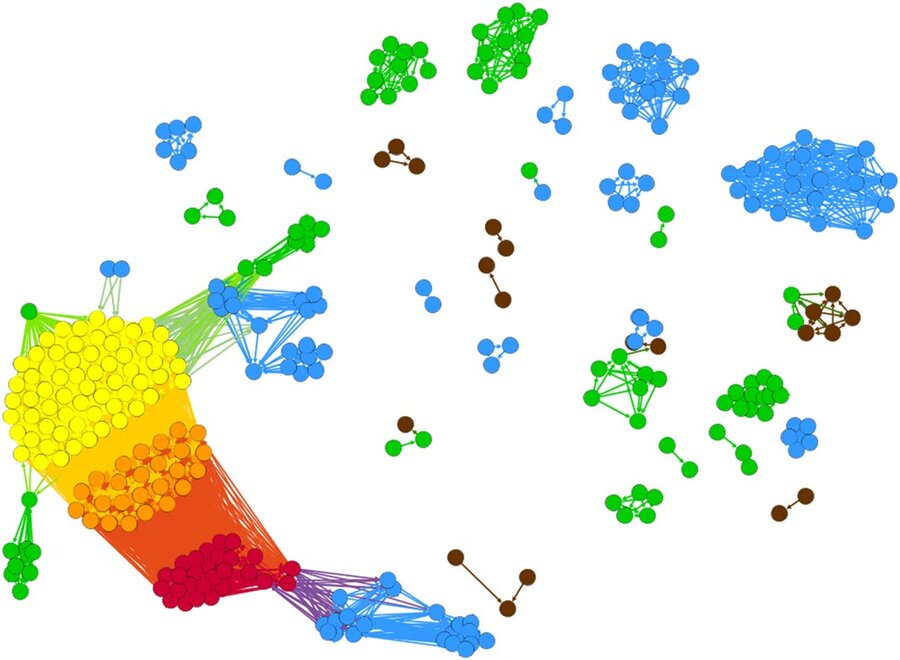
New paper: Evolution and …
Astronomy teaching changed substantially across two centuries of European universities. This paper analyzes more than 350 editions of the Sphaera Corpus — textbooks used to teach astronomy from the late fifteenth to the mid-seventeenth century — by building a six-layer multiplex network from the …