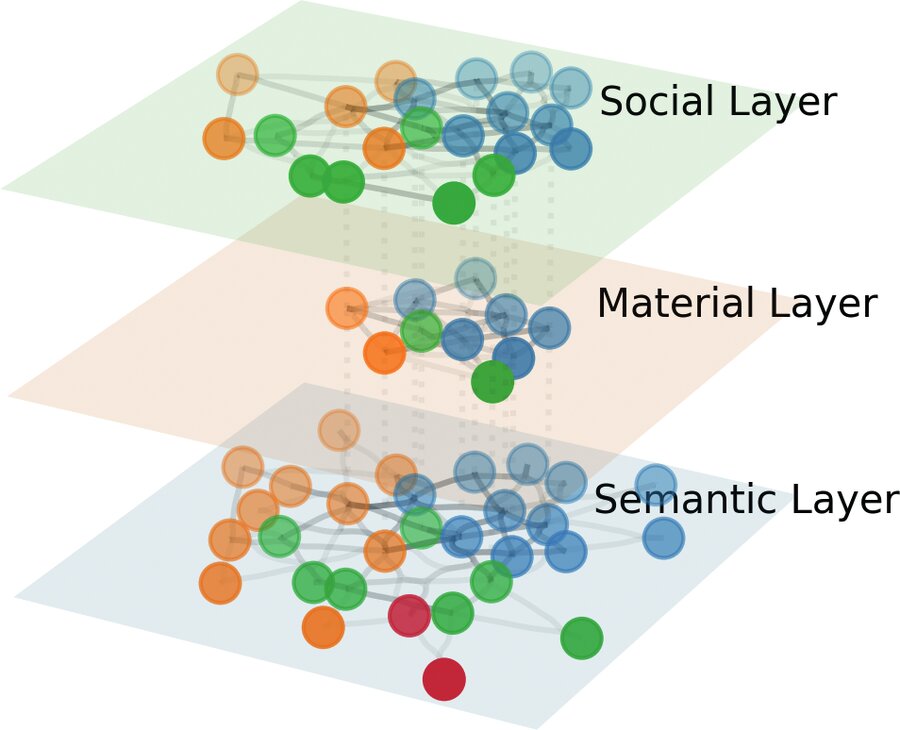
Focusing on network analysis, co-citation networks, and topic modelling, this chapter introduces the socio-epistemic networks (SEN) framework for studying how historical knowledge systems form and change. Applied to two case studies — transnational scientific practices of Polish migrants and the evolution of general relativity and gravitation research — it argues that social relationships, material objects, and cognitive content all need to be studied together to understand how knowledge develops over time.
Read the paper
- Authors: Aleksandra Kaye, Raphael Schlattmann, Malte Vogl, Bernardo S. Buarque, Jascha Schmitz, Lea Weiß, and Laura von Welczeck
- In: History of Intellectual Culture 3/2024: Experimental Spaces — Knowledge Production and Its Environments in the Long Nineteenth Century, ed. Charlotte A. Lerg, Johan Östling, Jana Weiß, Anne Kwaschik, and Claudia Roesch (De Gruyter Oldenbourg, 2024)
- DOI: 10.1515/9783111291383-012
- Featured image: figure from the chapter (the three layers of the socio-epistemic networks framework)