Software
New: Participating in the …
DHTech’s community code review process — described in Code review in digital humanities — pairs researchers who submit a piece of code with reviewers and a facilitator, working around the fact that most DH developers work alone. I’ve taken part on both sides of that pairing: submitting …
New workshop: How to …
When in the research lifecycle do small interventions yield the largest gains in code, workflow, and research quality? This hands-on workshop combines two initiatives working on that question from different angles — CODECHECK, which independently checks computational workflows as part of peer …
New workshop: Publishing …
Version control gives researchers a complete history of every change to their code, letting them experiment freely without fear of losing a working version. This beginner-friendly, one-hour virtual workshop demystifies Git and GitHub for researchers who haven’t used them before: a brief …
New lesson: Simulating …
This Programming Historian lesson introduces agent-based modeling as a method for historical research, using the Python package mesa. Learners build a simulation of early modern letter-exchange networks — the Republic of Letters — starting from the basic concepts (what a simulation is; agents, …
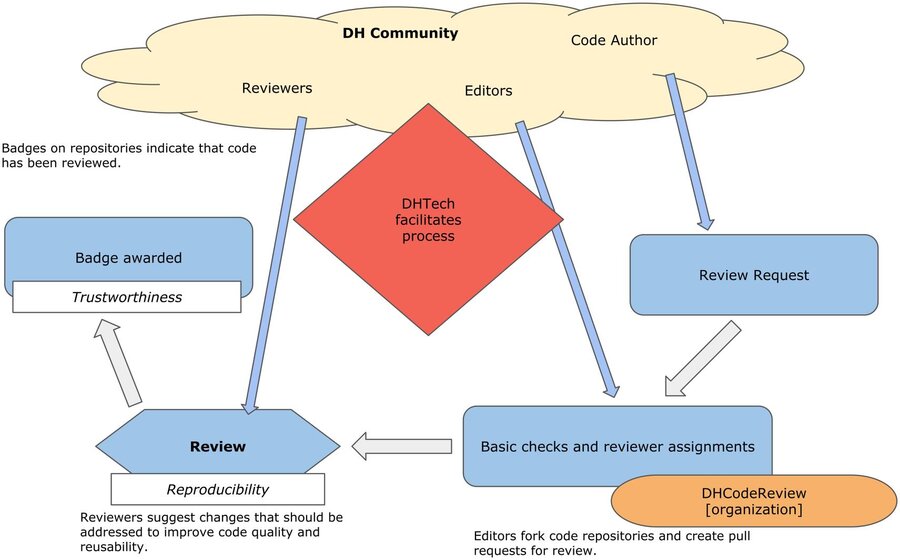
New paper: Code Review in …
Software errors can quietly undermine digital humanities research, but code review — a standard quality-control practice in software engineering — is hard to do when most DH developers work alone or in teams of one to three. This paper shares progress and insights from an effort to establish a …
New interactive …
Books as Knowledge Reservoirs is an interactive Jupyter Book that introduces the full pipeline of distant reading — from OCR and data cleaning through keyword analysis to network visualization — while examining the biases and pitfalls that come with computational approaches to text. It grew out of a …